volleyball stats sheet pdf

Volleyball Stats Sheet PDF: A Comprehensive Guide (Updated 01/23/2026)
Today’s date is 01/23/2026. This guide details utilizing PDF stat sheets for volleyball, covering tracking hitting, blocking, serving, and digging statistics effectively.
These sheets, available for free download, are essential for coaches and managers seeking organized data collection during matches and practices.
Volleyball stats tracking is fundamental for evaluating player performance and informing strategic decisions. A well-maintained volleyball stats sheet, often in PDF format, provides a detailed record of individual and team contributions during a match.
These sheets categorize data – hitting, serving, passing, blocking, and digging – allowing coaches to identify strengths and weaknesses. Tracking stats isn’t merely about numbers; it’s about understanding the why behind those numbers.
Analyzing serve receive ratings (0-3 scale) or kill efficiency reveals areas for improvement. Utilizing these insights, coaches can tailor training regimens and optimize in-game tactics, ultimately enhancing team success. The PDF format ensures easy access and portability.
Why Use a Volleyball Stats Sheet?
Volleyball stats sheets, particularly in PDF format, offer numerous benefits. They provide objective data, moving beyond subjective impressions of player performance. This data informs coaching decisions, allowing for targeted skill development and strategic adjustments during matches.
Tracking stats like aces versus errors reveals serving effectiveness, while analyzing pass ratings (0-3) highlights reception strengths.
A PDF stats sheet facilitates consistent data collection across games and seasons, enabling trend analysis. Coaches can identify patterns in opponent weaknesses and exploit them. Ultimately, utilizing stats empowers teams to play smarter, not just harder, leading to improved results.
PDF vs. Digital Stat Sheets
PDF volleyball stat sheets offer simplicity and portability – no devices needed! They’re ideal for situations with limited technology access, like some high school gyms. However, they require manual calculation and data entry, potentially increasing errors and time spent on analysis.
Digital sheets, like Google Sheets or dedicated apps, automate calculations and offer real-time insights. They streamline data management and facilitate more in-depth analysis.
The choice depends on your needs: PDF for basic tracking and simplicity, digital for advanced analytics and efficiency. Many coaches start with PDF and transition as their program evolves.

Key Statistical Categories
Essential volleyball stats include hitting, serving, passing, blocking, and digging metrics, providing a comprehensive view of player and team performance during matches.
Hitting Statistics
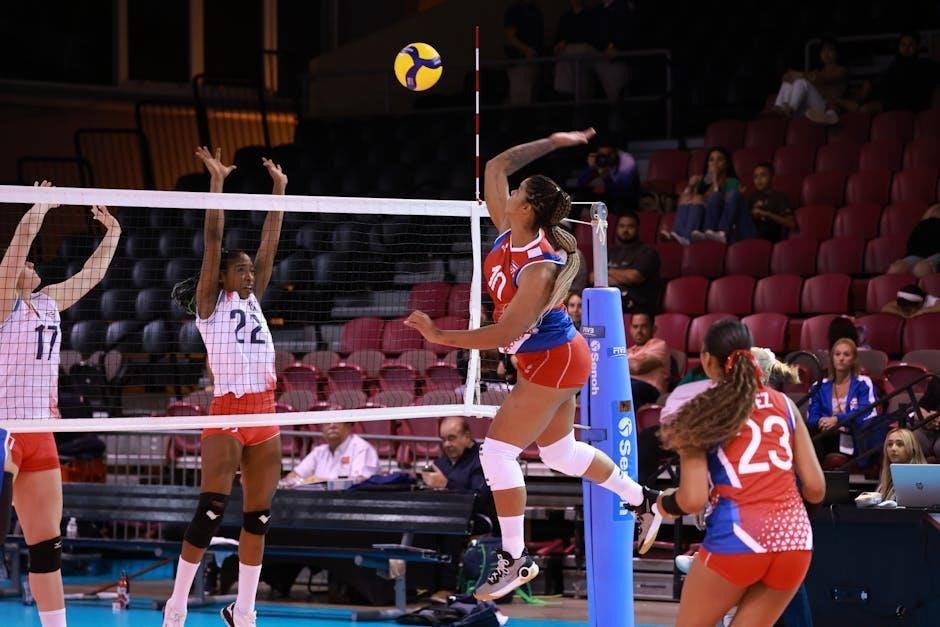
Tracking hitting statistics is crucial for evaluating offensive performance. Kills represent successful attacks that terminate in a point, while attack attempts denote the total number of offensive swings. Hitting errors indicate unsuccessful attacks that land out of bounds, are blocked, or hit into the net.
Calculating hitting percentage – (Kills ⎻ Hitting Errors) / Attack Attempts – provides a valuable metric for assessing offensive efficiency. A higher percentage signifies a more effective hitter. Coaches utilize these stats to identify strengths and weaknesses, adjust offensive strategies, and monitor player development throughout the season.
Kills
Kills on a volleyball stats sheet represent the number of times a player successfully hits the ball over the net, resulting directly in a point for their team. This is a fundamental offensive statistic, showcasing a player’s ability to terminate rallies.
Accurately recording kills requires careful observation during each point. A kill is awarded when the opposing team cannot legally return the ball. Tracking kills helps identify primary offensive threats and evaluate the effectiveness of different attacking strategies. Coaches analyze kill totals to assess player performance and make informed decisions regarding lineup adjustments.
Hitting Percentage
Hitting Percentage is a crucial metric on a volleyball stats sheet, calculated by subtracting hitting errors from total kills, then dividing that result by total attack attempts. This percentage reveals a player’s offensive efficiency. A higher hitting percentage indicates a more effective attacker.
The formula is (Kills ⎻ Hitting Errors) / Total Attempts. Coaches use this statistic to evaluate players beyond just kill totals, considering how often they score without making errors. It provides a more nuanced understanding of offensive performance and helps identify areas for improvement in technique and shot selection.
Attack Attempts
Attack Attempts, meticulously recorded on a volleyball stats sheet, represent the total number of times a player attempts to score by hitting the ball offensively. This statistic is vital when calculating hitting percentage, a key indicator of offensive efficiency. Tracking attack attempts provides context to a player’s kill total; a high number of attempts with a reasonable kill count demonstrates aggressive play.
Coaches analyze attack attempts to assess a player’s willingness to take swings and identify patterns in their offensive choices. It helps determine if a player is being utilized effectively within the team’s offensive system and informs strategic adjustments during matches.
Hitting Errors
Hitting Errors, a crucial component of any volleyball stats sheet, document instances where a player’s attack results in the ball landing out of bounds, hitting an antenna, or being illegally contacted. These errors directly impact a team’s scoring potential and are carefully monitored by coaches. Tracking hitting errors, alongside attack attempts, is essential for calculating hitting percentage – a key metric for evaluating offensive performance.
Analyzing hitting errors reveals patterns in a player’s mistakes, helping identify areas for improvement in technique, shot selection, or decision-making. Reducing hitting errors is a primary focus for offensive development.
Serving Statistics
Serving Statistics are fundamental to evaluating a team’s ability to initiate offense and disrupt the opponent. A comprehensive volleyball stats sheet meticulously records Aces – serves that directly result in a point – and Serving Errors, which give possession to the opposing team. Tracking Serve Attempts allows for calculating Serving Percentage, a key indicator of consistency and reliability.
Coaches utilize these stats to assess server effectiveness, identify strong and weak servers, and strategize serving locations. Some coaches even detail where serves land and the resulting pass quality.
Aces
Aces represent a direct point scored by a serve that the opposing team cannot successfully return, and are a crucial statistic on a volleyball stats sheet. Recording the number of Aces per player, and overall team total, provides valuable insight into serving prowess and its impact on scoring.
Analyzing ace frequency helps identify players with particularly effective serves, allowing coaches to strategically utilize them during critical moments. Tracking aces, alongside serving errors, paints a complete picture of a server’s risk-reward balance and overall contribution to the team’s offensive efforts.
Serving Errors
Serving Errors are instances where a serve fails to legally land within the opponent’s court, resulting in a point for the receiving team. A comprehensive volleyball stats sheet meticulously records these errors per player, offering critical data for evaluating serving consistency and accuracy.
High error counts can indicate a need for technique refinement or a more conservative serving strategy. Analyzing serving errors, in conjunction with ace totals, reveals a server’s overall effectiveness and risk assessment. Coaches utilize this data to optimize serving rotations and improve team performance.
Serve Attempts
Serve Attempts represent the total number of times a player attempts to serve during a match. Tracking serve attempts is crucial for calculating serving percentage, a key metric for evaluating a server’s reliability and consistency. A detailed volleyball stats sheet provides dedicated space to record each attempt accurately.
This data, combined with ace and error counts, offers a holistic view of a player’s serving prowess; Analyzing serve attempts helps coaches identify servers who consistently put the ball in play and those who may benefit from focused practice to improve their accuracy and reduce errors.

Serving Percentage
Serving Percentage is a vital statistic calculated by dividing the total successful serves (serve attempts minus serving errors) by the total serve attempts, then multiplying by 100. A volleyball stats sheet PDF simplifies this calculation by providing designated fields for recording serve attempts and errors.
This percentage indicates a server’s consistency and reliability in getting the ball over the net. Coaches utilize serving percentage to assess player performance, identify areas for improvement, and make informed decisions regarding serving rotations. A high serving percentage is indicative of a strong and dependable server.
Passing/Reception Statistics
Passing/Reception Statistics are crucial for evaluating a team’s ability to handle opponent serves and attacks. A comprehensive volleyball stats sheet PDF includes metrics like Pass Rating, typically on a 0-3 scale, assessing the quality of each pass – 0 being a poor pass, 3 being excellent.
Serve Receive Percentage, calculated similarly to serving percentage, measures the team’s effectiveness in receiving serves. Tracking these stats allows coaches to identify strong and weak passers, refine defensive strategies, and improve overall ball control. Accurate recording on the PDF sheet is key for insightful analysis.

Pass Rating (0-3 Scale)
Pass Rating, a fundamental component of volleyball stats sheets, utilizes a 0-3 scale to objectively assess the quality of each pass made by a player. A 0 indicates a significantly flawed pass, often unplayable, while a 1 represents a playable pass requiring considerable effort from the setter.
A 2 signifies a good pass, allowing the setter to execute the offense efficiently, and a 3 denotes an excellent pass, providing optimal setting opportunities. Consistent tracking of pass ratings on a PDF sheet reveals individual player strengths and weaknesses, informing targeted training and strategic adjustments.
Serve Receive Percentage

Serve Receive Percentage is a crucial metric recorded on volleyball stats sheets, quantifying a team’s ability to handle opponent serves. Calculated by dividing the number of successful serve receives by the total serve attempts, it provides a clear indication of passing efficiency.
A high percentage demonstrates strong passing fundamentals and effective communication, while a low percentage signals areas needing improvement. Tracking this stat on a PDF sheet allows coaches to identify weaknesses in serve receive formations and individual player performance, leading to focused practice drills and strategic adjustments during matches.
Blocking Statistics
Blocking Statistics are vital components of a comprehensive volleyball stats sheet PDF, revealing a team’s defensive presence at the net. Key metrics include Solo Blocks – a block achieved by a single player – and Block Assists, credited to multiple players involved in a successful block.
Total Blocks, the sum of solo and block assists, provides an overall measure of blocking effectiveness. Accurate tracking allows coaches to assess individual blocking prowess and identify strong blocking partnerships. Analyzing these stats helps refine blocking schemes and improve defensive strategies, ultimately hindering opponent attacks.
Solo Blocks
Solo Blocks, meticulously recorded on a volleyball stats sheet PDF, represent a significant defensive play where a single blocker successfully prevents an opponent’s attack without assistance. This statistic highlights an individual player’s ability to read the attacker and time their jump effectively.
Tracking solo blocks provides valuable insight into a player’s individual defensive skills and net presence. A high number of solo blocks indicates strong individual blocking ability and can influence opponent’s attacking decisions. Coaches utilize this data to recognize exceptional defensive performances and refine blocking techniques.
Block Assists
Block Assists, a crucial component tracked on a volleyball stats sheet PDF, signify collaborative defensive efforts. This statistic is awarded when two or more players contribute to a block, successfully hindering an opponent’s attack. Both blockers receive a block assist credit, regardless of which player makes initial contact with the ball.
Recording block assists provides insight into team blocking coordination and communication. A high number of assists demonstrates effective teamwork at the net. Coaches analyze this data to assess blocking partnerships and improve overall team defensive strategy, fostering a stronger, more cohesive blocking presence.
Total Blocks
Total Blocks, a key metric on a volleyball stats sheet PDF, represents the cumulative number of blocks a player contributes to during a match. This figure is calculated by summing a player’s Solo Blocks and Block Assists. Tracking total blocks provides a comprehensive view of a player’s defensive impact at the net.
Coaches utilize this statistic to evaluate a player’s overall blocking prowess and effectiveness. A higher total block count indicates a stronger defensive presence, disrupting opponent attacks and creating scoring opportunities. Analyzing total blocks helps identify top blockers and refine team blocking schemes.
Defensive Statistics
Defensive Statistics are crucial components of a comprehensive volleyball stats sheet PDF, offering insights into a team’s ability to prevent opponent scores. Key metrics include Digs, representing successful attempts to prevent the ball from hitting the floor after an opponent’s attack, and Digging Percentage, which assesses digging efficiency.
Tracking these stats helps coaches evaluate players’ defensive skills and identify areas for improvement. Analyzing dig numbers reveals strong defensive players and highlights weaknesses in defensive coverage. Effective defensive statistics provide valuable data for strategic adjustments and optimizing team performance.
Digs
Digs, a fundamental defensive statistic on a volleyball stats sheet PDF, record the number of successful defensive plays where a player prevents the ball from touching the floor after an opponent’s attack. Accurately tracking digs provides valuable insight into a player’s reactive skills and court coverage.
Coaches utilize dig totals to assess individual defensive performance and identify players excelling in ball control. High dig numbers indicate strong defensive capabilities, while low numbers may signal areas needing improvement. Consistent dig tracking aids in evaluating defensive strategies and making informed player substitutions.
Digging Percentage
Digging Percentage, a more nuanced metric on a volleyball stats sheet PDF, assesses a player’s efficiency in converting dig attempts into successful plays. It’s calculated by dividing total digs by total attempts to dig the ball, offering a percentage representing successful defensive actions.
This statistic provides a clearer picture of defensive skill than simply tracking dig totals. A higher digging percentage indicates a player consistently makes effective plays on challenging attacks. Coaches use this data to evaluate defensive technique and identify players who consistently secure possession after opponent attacks, improving overall team defense.

Designing Your Volleyball Stats Sheet
Effective stat sheet design includes essential elements like player names, statistical categories, and spaces for recording data during matches, ensuring clear and organized tracking.
Essential Elements of a Stats Sheet
A comprehensive volleyball stats sheet must include key components for effective data recording. Firstly, clearly designated spaces for each player’s name are crucial for individual tracking. Secondly, distinct columns for hitting statistics – kills, attempts, errors, and hitting percentage – are essential.
Furthermore, sections for serving stats (aces, errors, attempts, percentage), passing ratings (0-3 scale), serve receive percentage, blocking stats (solo, assists, total), and defensive stats (digs) are vital.
Finally, a dedicated area for noting set scores and substitutions enhances the sheet’s overall utility. These elements ensure a complete and organized record of game performance, aiding in player evaluation and strategic adjustments.
Customization Options for Different Levels (High School, Club, College)
Volleyball stats sheet customization should align with the level of play. High school sheets can focus on basic stats – kills, aces, digs – for simpler analysis. Club teams might add serve location tracking and more detailed passing assessments.
College-level sheets demand comprehensive data, including advanced hitting metrics like kill efficiency ratio and detailed opponent analysis sections. Coaches can tailor sheets by adding or removing categories based on their priorities.
PDF sheets offer limited editing, but pre-designed templates cater to different levels. Digital sheets provide greater flexibility, allowing for customized formulas and automated calculations.
Free Printable Volleyball Stats Sheet Resources (PDF)
Numerous online resources offer free, printable volleyball stats sheets in PDF format. These sheets typically include sections for tracking hitting statistics (kills, errors, attempts), serving stats (aces, errors), passing ratings, blocking data (solo, assists), and defensive digs.
Many coaches prefer printable sheets for their simplicity and ease of use during matches. Searching online for “free volleyball stats sheet PDF” yields various options, catering to different preferences regarding layout and included statistics.
These resources provide a convenient, low-cost solution for teams needing to record player performance data manually, perfect for high school or club-level play.

Utilizing Digital Volleyball Stats Sheets
Digital sheets, like Google Sheets and dedicated apps, offer efficient volleyball stat tracking, surpassing traditional PDFs with automated calculations and enhanced analysis capabilities.
Google Sheets Templates for Volleyball Stats
Leveraging Google Sheets provides a dynamic alternative to static PDF volleyball stat sheets. Numerous free templates are readily available online, offering pre-built formulas for calculating hitting percentage, serve receive rates, and other key metrics.
These templates allow for real-time data entry during matches, automatically updating statistics as play unfolds. Collaboration is seamless, enabling multiple scorekeepers to contribute simultaneously. Customization is a significant benefit; coaches can tailor templates to emphasize specific data points relevant to their team’s strategy.
Furthermore, Google Sheets facilitates easy data visualization through charts and graphs, aiding in performance analysis and opponent scouting. The cloud-based nature ensures accessibility from any device with an internet connection.
Volleyball Stat Tracking Apps
Dedicated volleyball stat tracking apps represent a modern evolution from traditional PDF stat sheets. These applications, often available for both iOS and Android, streamline the data collection process with user-friendly interfaces and pre-programmed statistical calculations.
Many apps offer features like roster management, real-time scoring, and automated report generation. Some even provide advanced analytics, such as heatmaps of serve locations and player efficiency ratings. While some apps are free, others require a subscription for full functionality.
For high school or club levels, free versions often suffice, providing essential tracking capabilities; These apps minimize manual calculations and enhance the speed and accuracy of stat recording.
Benefits of Digital Stat Tracking
Transitioning from PDF stat sheets to digital tracking offers numerous advantages for volleyball teams. Digital systems eliminate the risk of lost or damaged paper sheets and simplify data entry, reducing errors. Real-time data visualization allows coaches to make informed decisions during matches, adjusting strategies based on current performance.
Automated calculations save valuable time, and the ability to generate comprehensive reports facilitates in-depth player and opponent analysis. Cloud storage ensures data accessibility across multiple devices, fostering collaboration among coaching staff.
Ultimately, digital tracking empowers teams to optimize performance through data-driven insights.

Advanced Stats & Analysis
Utilizing collected data, coaches can calculate advanced metrics like Kill Efficiency Ratio to assess player performance and refine team strategies effectively.
Advanced Hitting Metrics (e.g., Kill Efficiency Ratio)

Beyond basic hitting stats, advanced metrics offer deeper insights into offensive performance. Kill Efficiency Ratio (KER) is a prime example, calculated by dividing kills by total attack attempts. This provides a percentage indicating hitting effectiveness, factoring in errors. Analyzing this ratio, alongside hitting percentage, reveals a more nuanced understanding of a hitter’s contributions.
Further analysis can include tracking hitting zones, identifying preferred sets, and evaluating performance under pressure. A comprehensive volleyball stats sheet PDF facilitates gathering the necessary data for these calculations, empowering coaches to make informed decisions regarding lineups and training regimens, ultimately maximizing offensive potential.
Opponent Analysis Using Stats
A valuable application of volleyball stats sheets is dissecting opponent tendencies. By meticulously recording their statistics – hitting zones targeted, serve receive weaknesses, and blocking schemes – coaches can identify patterns and vulnerabilities. A well-maintained PDF stat sheet becomes a crucial scouting tool, revealing preferred attacker locations and predictable play calls.
This data informs strategic adjustments, allowing teams to exploit weaknesses and neutralize threats. Analyzing opponent serving statistics can dictate receive formations, while identifying key hitters guides blocking assignments. Effective opponent analysis, fueled by detailed stats, significantly enhances a team’s competitive edge.
Using Stats to Improve Team Performance
Volleyball stats sheets aren’t just for post-match analysis; they’re powerful tools for driving team improvement. Tracking individual and collective performance metrics – hitting percentages, serve receive ratings, and digging success – reveals areas needing focused attention. Identifying players excelling or struggling in specific skills allows for tailored training drills and personalized coaching.
Consistent stat tracking fosters accountability and motivates players to refine their game. Analyzing trends over time highlights progress and pinpoints persistent weaknesses. Utilizing PDF stat sheets provides concrete data to support coaching decisions and optimize team strategies, ultimately leading to enhanced performance.